
AEC project managers are expected to juggle technical project delivery and commercial performance. Maintaining the balance between the two is not always easy. With three fundamental concepts that help PMs manage the tradeoffs between scope, schedule, and budget, there’s hope. Armed with knowledge and tools, PMs can develop work breakdown structures to ensure projects are set up for success, apply earned value management to keep projects on track, and take advantage of AI agents and predictive analytics to improve project outcomes, enabling them to spend less time on admin and more time with project teams and clients. Together, these ideas offer a practical foundation for stronger project outcomes.
The Role of the AEC Project Manager
The architecture, engineering, and environmental consulting (AEC) industry is a vibrant and vital professional services sector driven by projects that require careful attention technically and commercially. While many AEC project managers have solid technical credentials given their education and experience, their commercial knowledge can lag behind and impact successful project outcomes.
Project managers focus on managing and delivering projects that not only meet client expectations but also meet the internal expectations set by the firm’s financial, operational and technical guidelines. Beyond this hefty responsibility, PMs also have a ton of project management concepts to keep up with, which can get pretty time consuming, especially if their background doesn’t include formal business training.
After almost three decades of experience in the business of design, I’ve identified three key concepts every project manager in the AEC industry should know to drive their projects to commercial success.
Create a Winnable Game
Let’s start with the basics, which project managers across all industries must stay rooted in to be effective. By definition, a project is a temporary endeavor that is meant to end. In other words, when a project doesn’t seem to have a finish line, it’s been poorly managed.
Another fundamental aspect of projects is that they are inherently constrained, and not just from a scheduling perspective. In fact, the project management triangle concept shows how a project’s scope, schedule and budget form boundaries around the outcomes. One of the essential responsibilities a PM has is to set projects up for success by embracing these constraints.
To drive a project forward, a PM must constantly measure and balance the project’s scope, schedule, and budget performance. For example, the PM may need to go back to the client with a change order to expand the budget, or they may need to reallocate resources to remove a bottleneck and get the project back on schedule. Either way, the PM must always stay on top of each constraint to make sure the project will meet the expectations of the project management triangle, thus creating a winnable game.
Successful outcomes are not just determined during project delivery — they are set in motion before the project even begins. Creating a winnable game starts with organizing a project’s scope in a thoughtful manner that reflects how the project will be executed and controlled. The PM can do this by developing a cohesive work breakdown structure (WBS).
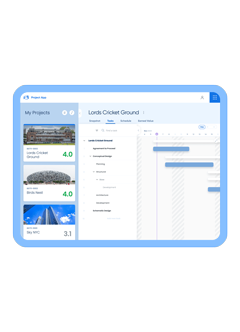
Tasks are the building blocks of a well-developed WBS. Each task represents discrete items of work, usually organized in a hierarchical manner, where parent tasks group together sets of related tasks, ultimately creating specific work packages. A project manager should develop a project WBS into these component work packages so they can be tracked and managed in the context of the project management triangle. Thoughtful scope decomposition is a critical step in setting a project up for success.
Time Is Money
In a professional services environment, projects take on an added commercial dimension, as time is not just figuratively but literally money. AEC firms make (or lose) money based on the time they spend delivering projects, so the more effective a PM is with project scheduling, the more efficient they will be in completing their projects. A helpful way to monitor the intersection of time and money on a project is with earned value management (EVM).
A project manager needs to create performance metrics that determine a project’s profitability. Part of this is being able to proactively identify project trends and issues before they happen and take corrective action. The core EVM metrics a PM should be tracking include:
- Planned Value or the income or fee a firm expects to earn for the work performed, representing the revenue a project is expected to earn through completion.
- Earned Value or the amount of work delivered against budget that is reported as revenue — more suitably termed earned revenue for AEC firms — as it represents the revenue a project earns as work is performed.
- Actual Cost or the market/retail value of the cost a project incurs as work is performed, which allows consultancies to compare the amount of effort expended on a project to its planned revenue and earned revenue.
A great tool to use when evaluating these metrics is the S-curve graph, which brings planned value, earned value, and actual cost together and charts the path that the project has traveled, showing its current status and where it’s heading. S-curves display cumulative EVM factors against time, providing a simple yet insightful visual that can help optimize the schedule and financial trajectory of projects. Using EVM concepts helps a PM to gain more insight into the status of their projects and take quick corrective action when issues arise that threaten to derail project profitability.
Harness AI
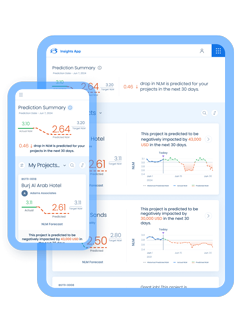
The project manager is the linchpin of any project, and that amount of responsibility can be daunting. Thankfully, advancements in artificial intelligence provide project managers capable assistance — and assistants — in the form of predictive analytics and AI agents. While predictive analytics pre-dates artificial intelligence, AI technologies like machine learning and generative AI have advanced the field.
Project managers can now benefit from software applications — integrated with the business systems they’re already using — that can predict project outcomes based on a variety of digital signals. With many AEC project managers managing portfolios of 10 to 20 projects or more, having predictive analytics tools that can highlight which projects are at risk to miss profitability targets, for example, allows them to focus their valuable time on the specific projects in their portfolio that require special attention.
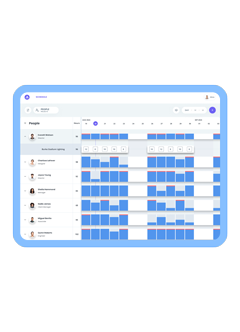
AI agents provide another way to clear the brush that hinders effective project management. Simply put, AI agents are semi- to fully-autonomous software systems that can respond to prompts or even act on their own to make decisions, provide guidance and complete tasks in collaboration with people or other agents. For project managers, AI agents can help across the project life cycle, from project pursuit and estimating to project setup and planning through to project execution and closure. With today’s agent-ready business systems, project managers and their firms can create their own tailored agents that leverage structured data in their existing databases as well as unstructured data that resides in proposals, contracts, emails and other digital sources.
The intersection of project management and artificial intelligence is evolving in real time, but what’s already possible offers great benefits to project managers looking to spend less time on administrative tasks and more time with their clients and project teams.
Key Takeaways
Creating a winnable game by devising a work breakdown structure, applying earned value management strategies to navigate the intersection of time and money, and harnessing the power of AI to improve project outcomes and optimize time management are three fundamental business concepts every AEC project manager needs in today’s world — emphasis on fundamental. There are many terms and concepts that project managers ought to know, so consider this just a starting point. Speaking of AI, ideally a PM also has accounting intelligence (i.e., a project accountant) at their side to stay on top of the related aspects of project success.
For more information, read the other installments in The Business of Design blog series and expand your knowledge with The Ultimate ERP Glossary for AEC Firms — a comprehensive list of 150 AEC industry terms that cover the entire project lifecycle.